

Find Your Kids Activity
Find Your Kids Activity
Your search results
How Parents Can Support Language Learning at Home Without Speaking the Language Themselves
Discover practical ways parents can support language learning at home through daily routines, reading, games, and encouragement — even without speaking the language themselves.

Many parents assume that supporting their child’s language learning at home requires near-perfect fluency in the target language. That assumption, while understandable, undersells what parents actually contribute to language development.
Research backed by government research shows that children thrive linguistically when their home environment is warm, consistent, and communicative, not when it mirrors a formal classroom. A parent who reads aloud, asks questions, and responds with genuine praise and encouragement does more for acquisition than one who drills vocabulary with anxiety about getting it right.
Using the home language freely is also far more helpful than many parents realize. Maintaining a strong native language foundation actually supports second language acquisition rather than competing with it, a finding that holds across decades of bilingualism research. Children who feel secure in one language build transferable skills that carry into the next.
Concerns about making mistakes or causing confusion are common, but the evidence consistently points in the same direction: connection and consistency matter far more than pronunciation.
Yes, You Can Help Even If You Are Not Fluent
Language development at home is not about perfect pronunciation or flawless grammar. It is about keeping communication warm, regular, and encouraging. A parent who stays engaged, asks questions, and responds with genuine praise and encouragement does more for a child’s progress than one who steps back out of fear of getting something wrong.
Maintaining a strong home language foundation actually supports second language acquisition rather than holding it back. This is a well-documented finding across decades of bilingualism research, and it means that speaking your native language confidently at home is a contribution, not a complication. Children who feel secure in one language build transferable skills that carry naturally into the next.
Worries about making mistakes or confusing a child are understandable, but the evidence is consistent: connection and consistency matter far more than accuracy.
Build Language Practice into Everyday Routines
Turning daily life into language practice does not require lesson plans or fluency. It simply requires intention and repetition, both of which any parent can offer.
Use Meals, Chores, and Bedtime as Talk Time
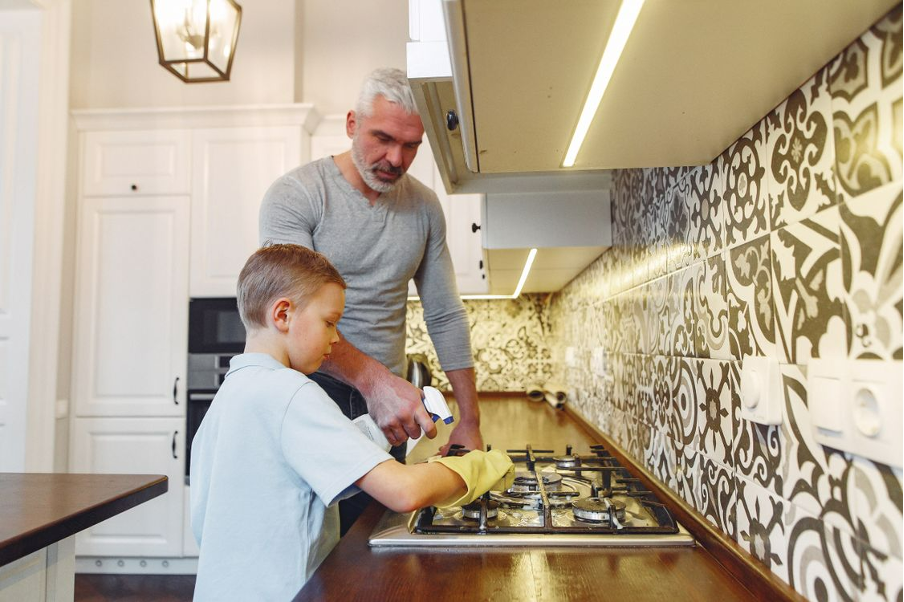
Daily routines are some of the most underused opportunities in language learning at home. Mealtimes, folding laundry, washing dishes, and the quiet stretch before bed all offer natural windows for conversation that do not require preparation or fluency.
A parent can name what is on the table, ask a child to describe their day in the target language, or simply narrate what they are doing together. These moments create the kind of low-pressure repetition that supports vocabulary development far more reliably than structured drills. The goal is not perfection; it is consistent exposure through familiar, comfortable settings.
Bedtime routines are especially productive. Reading at home, even from picture books, builds comprehension and reinforces the same words across multiple nights, which is how children internalize language naturally.
Keep Prompts Simple and Repeatable
Parents who worry about communication barriers often overthink what they need to say. Simple, repeatable phrases do the heavy lifting. Asking “What’s this called?” or “How do you say that?” invites the child to take the lead without the parent needing to supply the answer.
Labeling household objects in the target language, using sticky notes or casual naming during chores, is one of the easiest ways to build a language-rich environment without formal lessons. Homework support can work the same way: a quick check-in during an evening routine keeps learning visible without turning it into a test.
Over time, these small repeated prompts do more than build vocabulary. They signal to children that language learning is part of everyday life, not something that only happens at school. Some families rely on teacher guidance, some build it into household routines, and some add an advanced AI language coach to give children extra listening or speaking exposure between school tasks and home practice.
Use Stories, Songs, and Play to Lower Pressure
Low-pressure activities are often the most effective ones. When children are relaxed and engaged, they absorb language more readily, and the activities described in this section are designed with exactly that in mind.
Read Together in Any Language You Know Well
Stories and songs have long been recognized as natural vehicles for language development, and they work regardless of which language a parent speaks most confidently. A parent reading aloud in their home language is not stepping away from English learning; they are building the literacy habits and comprehension skills that transfer directly into a second language.
Picture books, folk tales, and familiar nursery rhymes expose children to rhythm, repetition, and narrative structure, all of which strengthen listening and vocabulary over time. For English language learners especially, hearing fluent, expressive reading at home reinforces the idea that stories are worth engaging with in any language.
Parents do not need English-language materials to make this meaningful. Reading what they know well, with warmth and expression, is far more valuable than struggling through a text in an unfamiliar language.
Turn Games into Speaking and Listening Practice
Play-based activities give children room to practise without the pressure of being evaluated. Simple card games, guessing games, and storytelling games all build the same skills as formal lessons, including vocabulary recall, turn-taking, and comprehension, while keeping the mood light enough that mistakes feel insignificant.
A parent can introduce a rule where players name an object before picking it up, or ask a child to explain the rules of a game they already know. These small shifts create genuine speaking and listening practice through parent engagement that feels nothing like schoolwork.
Choose Tools That Support, Not Replace, Interaction
Digital tools have made it easier than ever for parents to bridge language gaps at home, but they work best when they complement interaction rather than replace it.
Google Translate and similar apps can be genuinely useful for checking the meaning of a word, hearing correct pronunciation, or understanding a homework instruction. However, what they struggle to replicate is the back-and-forth of real conversation, which is the part of language learning that actually drives acquisition.
For parents supporting a child with EAL (English as an additional language), the most effective approach treats digital tools as a reference point rather than a learning plan. Looking up a word together, then using it in a sentence at dinner, is far more productive than handing a child a device and walking away. A language-rich environment grows through repeated, real interactions, and simple tools used consistently alongside daily conversation and reading routines will always outperform sophisticated apps used in isolation.
Frequently Asked Questions
Can I support my child if I don’t speak the language well?
Yes. A parent’s role is to create a warm, communicative environment at home, not to act as a fluency model. Consistent encouragement, shared reading, and simple daily conversation all support acquisition meaningfully, even when communication barriers exist in the target language.
Will my child copy mistakes in my pronunciation or grammar?
Children are exposed to many language models, including teachers, peers, and media. Occasional mispronunciations from a parent rarely interfere with development. What matters far more is regular engagement and a positive relationship with the home language.
Should we stop using our home language to help them learn faster?
No. Research on bilingualism consistently shows that a strong native language foundation supports, rather than hinders, second language learning. Abandoning the home language often removes the very stability that helps children acquire new ones.
What Matters Most Is Showing Up Consistently
Children benefit far more from steady parent engagement than from flawless language modeling. Small, repeated actions at home, such as asking questions, reading together, and naming everyday objects, build confidence and signal that language learning is a normal part of daily life.
The goal has never been expert instruction. It has always been a supportive, language-rich environment where children feel safe to practise, make mistakes, and try again. Praise and encouragement, offered consistently, do more than any single resource or tool ever could.