

Find Your Kids Activity
Find Your Kids Activity
Your search results
Get Your Activity Business AI-Ready Before September: How Parents’ AI Finds You — and How to Run Classes by Voice
It’s a Tuesday evening in July, and a parent three streets from your venue picks up her phone. She doesn’t open Google and scroll. She asks: “Swimming lessons for a 4-year-old, Saturday mornings, near me — who’s any good?” A few seconds later she has her answer: two or three providers, with times, prices and a note about reviews. She messages one of them.
Here’s the question that should keep every activity provider up at night this summer: were you in that answer?
Because two things changed this year, and both land right before the September rush — the most important enrolment window of your year.
The first: parents have quietly stopped browsing and started asking. Google’s AI Overviews, ChatGPT, Gemini, the assistant in their phone — these now answer “a good toddler dance class near me” directly, in a sentence, naming a handful of providers. If an AI can’t read your classes, you’re not lower down the list or on page two. You’re simply not in the conversation.
The second: for the first time, you can run the whole business back — the bookings, the registers, the payment chasing, the “can we move to Thursdays?” messages — by talking to it. The admin ceiling that quietly caps most activity businesses around the 80-child mark just got a third way through, and it isn’t “work more Sundays” or “hire an admin you can’t yet afford.”
This is how to get ready for both before September: how to be found when the searcher is an AI, and how to run what follows when the enquiries land. You don’t need to become technical. You need an afternoon and this checklist.
What “AI-ready” actually means
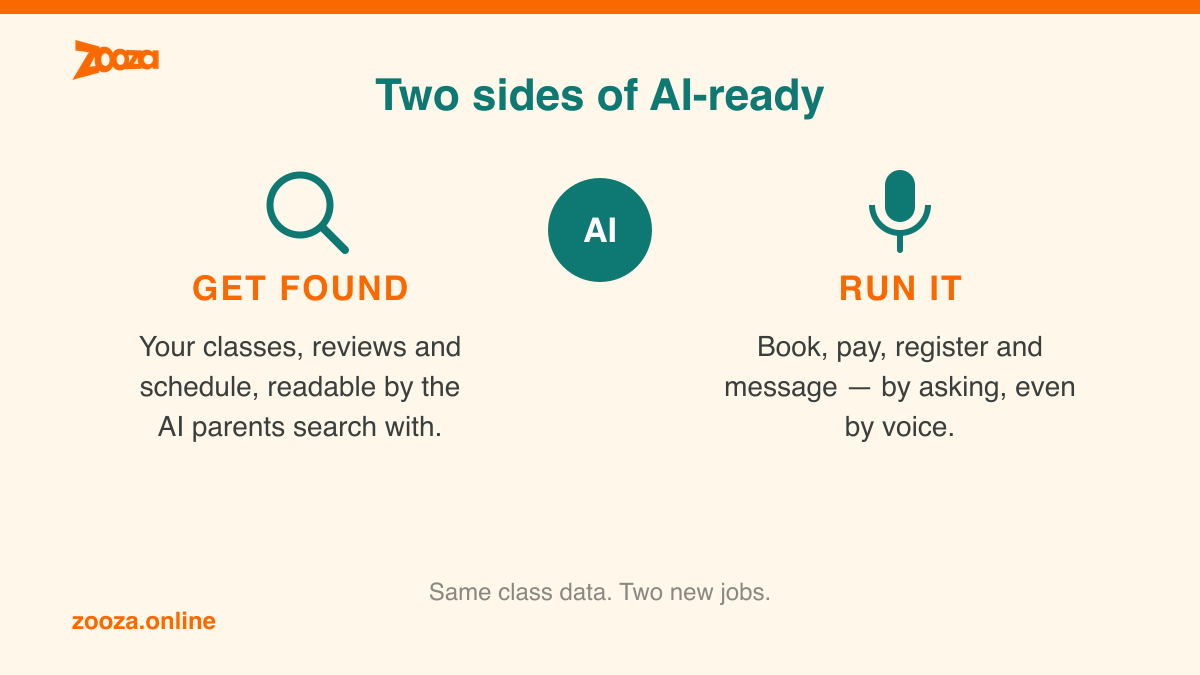
Let’s define it, because “AI-ready” gets thrown around and usually means nothing. For a children’s activity business it has two distinct sides:
Discovery readiness — being findable when a parent’s AI assistant answers a search, because your classes, times, prices and reviews are readable by a machine, not locked inside a booking widget or a photo.
Operational readiness — being able to run the business (enrolment, payments, registers, parent messages) through AI on your instruction, instead of by hand.
Most providers have neither, and don’t realise it, because until recently both were impossible. The software that runs a children’s activity business has spent a decade helping you take a booking and collect a payment. What’s new this year is that the same data can now be read by the AI a parent searches with — and acted on by an AI you talk to. Same data, two new jobs.
Side A: Getting found when the searcher is an AI
Start with the uncomfortable bit: an AI doesn’t shop the way a parent does. It doesn’t admire your photos, read your “about” page, or forgive a clunky website because the classes look fun. It reads text, checks a few signals, and moves on. Twenty seconds, no sentiment.
So the question isn’t “is my website nice?” It’s “can a machine actually read what I offer?” For most providers the honest answer is no — and not for want of trying. The information is there; it’s just in a form AI can’t see:
- It’s behind a booking button. If your times, ages and prices only appear after someone clicks “Book now” and a widget loads, an AI agent never gets there. To it, that page is a locked door — the single most common reason a good provider is invisible.
- It’s in a picture or a PDF. A beautiful timetable graphic says nothing to a machine. Neither does a downloadable price list.
- It’s vague. “Classes for all ages, get in touch!” is not an answer an AI can hand a parent who asked for “Tuesday, age 4, near Croydon.”
Here’s what AI agents actually reward — all fixable in an afternoon:
- Plain, published detail. Schedule, age groups, prices and availability as readable text on a public page — not gated, not an image.
- Reviews, recent and plenty. To an AI weighing who to recommend, twenty Google reviews and two hundred are not the same business — and this term’s reviews count for more than ones from three years ago. Ask every family, after every trial and every term.
- Answers to the real questions. A clear FAQ — “what should my child wear?”, “do you do a free taster?”, “what if we miss a week?” — gives the AI the exact lines to recommend you with confidence.
- An llms.txt file. The plainest way to tell an AI agent who you are and what you run. Most activity businesses have never heard of it; the ones that have are already ahead. (New to the term? It’s in our plain-English glossary.)
None of this needs you to become a technical SEO. It needs your class information to exist as machine-readable data — which is exactly what a modern booking platform should do for you in the background. Zooza, for instance, builds an AI-visibility layer — an llms.txt per location, structured data from your real schedule, and your reviews in a form AI can cite — from the data you already keep. The point isn’t the tool; it’s the principle: if your software can’t make you readable to AI, the September searcher won’t find you, however good your classes are.
Side B: Running it once they’ve found you
Say discovery works and the enquiries land. Now you meet the other wall — the one every growing activity business hits and nobody names.
Call it the admin ceiling. Somewhere around 80 children, one person’s evenings quietly fill: the register, the payment chases, the “can we switch to Thursdays?” messages, the waitlist juggling, the rained-off texts. Demand isn’t the problem — hours are. Each new child adds a few more minutes a week that have to come from somewhere, until there’s no Sunday night left to give. For a decade the only answers were “work more” or “hire admin you can’t yet afford.”
This year there’s a third, and it’s the genuinely new part: you can run the back office by talking to it. Not clicking through screens — asking. “Who hasn’t paid for Tuesday?” “Move Amelia to the Thursday group and let her mum know.” “Take the register for this morning.” “Tell Saturday football it’s cancelled for weather.” The system does it — by text, or out loud, on your phone between classes.
It sounds abstract until you watch it. One provider photographed the handwritten whiteboard timetable she already had, uploaded it, and typed a single line — “here’s my autumn schedule, create these classes.” Minutes later, 68 classes existed in her account, across her venues, with instructors matched by first name and October half-term already skipped. What used to be two days of work happened in the time it takes to make a coffee. (Watch it happen — a photo becomes a live schedule.)
This is the first time operators in our corner of the world can run a children’s activity business this way. I don’t say it lightly: Zooza’s AI Assistant was built to do exactly these operational jobs by instruction, including by voice — as far as we know, a first for this niche. Use us or not, this is the shift worth understanding before your busiest term: the providers who spend September coaching instead of doing data entry will simply have more room to grow.
One honesty, because it matters with children’s data: AI doing the admin doesn’t mean AI unsupervised. You still set the rules, still review what goes to parents, and anything touching a child’s information should stay inside a platform you trust — not pasted into a public chatbot. “Run it by voice” removes the drudgery, not the judgement.
What this looks like in your corner
The two shifts land differently depending on what you run. A few examples from the disciplines we work with most:
Dance and performance studios. Your year has a shape — termly enrolment, a recital season that turns costume orders and extra rehearsals into a second job, and families with one child in three classes. On the discovery side, a parent’s AI needs to see each class, level and age as plain text — “Grade 2 Ballet, Tuesdays 4:30, ages 7–9” — not a stylised timetable image. On the operations side, the recital-season admin (who’s paid for costumes, who’s in which routine, chasing the stragglers) is exactly the repetitive work you can now delegate by asking. Zooza’s dance-studio tools handle both from one place.
Football and multi-venue sports. Your complexity is spread: squads by age across several pitches, weather that cancels a whole morning, sibling discounts, coaches who need today’s register on their phone. Machine-readability matters doubly — a parent’s AI has to find the right venue near them — and “cancel Saturday for weather, tell everyone” is the poster child for running things by voice. This is where scale bites first. As franchise consultant Nick Empson puts it:
“The moment you go from one venue to five, consistency becomes the whole game — every site taking bookings, registers and payments the same way. That’s not more staff; that’s better systems.”
It’s why software built for kids’ football clubs keeps five venues running like one.
Baby, toddler and swim classes. Small classes, strict ratios, rolling termly intakes, and waitlists that genuinely matter — when a class holds six, one drop-out you don’t fill is real money. AI-readiness is make-or-break for discovery (parents almost always search “near me, this age, this day”), and waitlist-and-progression admin is precisely what shouldn’t eat your evenings. The same, for baby and swim classes: the moment a space opens, the next family is offered it, automatically.
Your September AI-readiness checklist
Screenshot this. Two sides, five checks each. If you can’t tick most of them before the intake wave, that’s your summer to-do list.
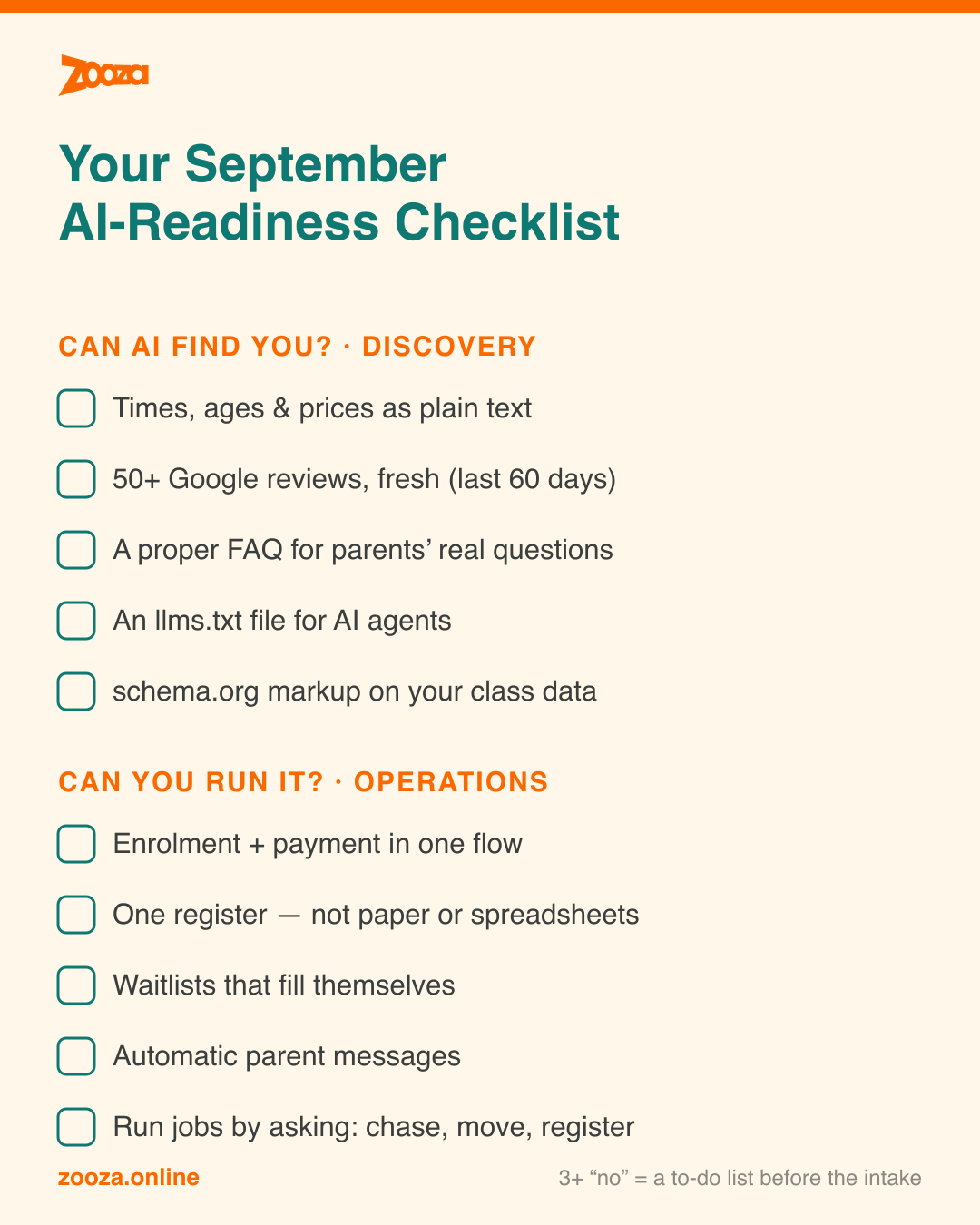
Can AI find you? (Discovery)
- Your class times, ages and prices are readable as plain text on a public page — not only inside a booking widget.
- You have 50+ Google reviews, with new ones from the last 60 days.
- Your website answers the real questions parents ask (a proper FAQ).
- You have an llms.txt file telling AI agents who you are and what you run.
- Your class data carries schema.org markup, so machines can parse it.
Can you run it once they arrive? (Operations)
- Enrolment and payment happen in one flow — no “pay on the day” leakage.
- Your register lives in one place, not on paper or a drifting spreadsheet.
- Waitlists fill themselves the moment a space opens.
- Parent messages — reminders, changes, cancellations — go out automatically.
- You can action the routine jobs — chase a payment, move a child, take a register — by simply asking, from your phone.
Score yourself honestly. If you answered “no” to three or more on either side, you have a readiness problem heading into the most important enrolment window of the year — and about eight weeks to fix it.
The questions providers are asking (and asking AI)
How do parents actually find children’s activities now — is it still Google?
Increasingly not the way you think. They still open Google, but more and more they get an answer, not a list — an AI Overview, or ChatGPT, Gemini and the phone’s assistant replying to “a good toddler swim class near me” with two or three names. The search bar is becoming a conversation, and the providers named in the reply get the enquiry.
Can a parent’s AI assistant actually recommend my club?
Only if it can read you. AI agents recommend businesses whose classes, times, prices and reviews they can parse — as text, not pictures, and not locked behind a booking button. Readable, and you’re a candidate; not, and you’re invisible however good you are.
Why can’t AI “see” my class times if they’re on my website?
Usually because they’re not “on” it in a way a machine reads — they’re inside a booking widget that only loads after a click, or baked into a timetable image or a PDF. A human clicks through and squints; an AI agent doesn’t. If the detail isn’t plain text on a public page, assume it’s invisible.
How many Google reviews do I need before AI recommends me?
No magic number, but volume and freshness both count — twenty and two hundred aren’t the same signal, and this term’s reviews outweigh ones from years ago. A practical target: 50+, with a steady trickle of new ones. Ask every family after every trial and term; it’s the highest-leverage thing you can do this summer.
What’s an llms.txt file — and do I really need one?
A short plain-text file on your website that tells AI agents exactly who you are and what you offer — the most direct way to speak their language. Not strictly required, but fast becoming the difference between being described accurately by AI and being guessed at or skipped.
Does my booking software help or hurt my AI visibility?
The question most operators forget to ask — and it matters, because software that buries your class data in a widget with no machine-readable output is working against you. Ask your provider directly: do you generate an llms.txt for my business, and is my schedule readable by AI agents? A blank look is your answer.
Can I really run my activity business by talking to it?
For the core operational jobs, yes — taking a booking, chasing an unpaid fee, moving a child, taking the register, messaging a class. You ask, in plain language or by voice, and it’s done. It won’t teach the class; it removes the repetitive admin around it.
Is it safe to let AI handle children’s data?
With one rule: keep it inside a platform built for it, not a public chatbot you paste names into. A purpose-built assistant works within your existing permissions and data protection; a general one you feed a spreadsheet does not. Automate the drudgery, never hand over control of the data.
Five ways to get this wrong
- Assuming a nice website is enough. It’s for humans. The AI deciding whether to mention you cares only what it can read.
- Hiding your best information. Times and prices behind “contact us” feel tidy; to an AI (and an impatient parent) they read as no answer.
- Letting reviews go stale. A wall of five stars from 2022 is weaker than a handful from this term. Recency is a signal.
- Pasting parent or child data into a public chatbot. Convenient, and a data-protection problem waiting to happen.
- Waiting until September. The searches that decide your autumn are happening now, over the summer, as parents plan the new term.
The window is open now
Come September, a parent three streets away will pick up her phone and ask for “a good class near me.” One of two things happens: your name is in the answer and the admin behind the enquiry runs itself — or it isn’t, and you never know the enquiry existed.
Neither outcome is about how good your classes are. Both are about whether you spent an afternoon this summer getting AI-ready, on both sides. You have the checklist. You have the time, just. The providers who use it walk into their busiest term found — and free to actually teach.
Michal Dodok is the co-founder and CEO of Zooza, the platform for running children’s activity businesses — including an AI Assistant that lets operators run bookings, payments and parent comms by talking to it, by voice. With additional insight from Nick Empson, franchise consultant.